The post-purchase window has quietly become the most important part of e-commerce. A shopper who clicks "Buy" is no longer judging your site, your prices, or your photography — they are judging your delivery experience. And in 2025, that experience is being rebuilt around artificial intelligence.
According to IBM's Institute for Business Value, organizations that have matured their AI adoption report a 17% higher customer satisfaction score than their peers. In logistics specifically, 49% of consumers say they want AI assistance for tracking deliveries — more than for any other use case.
Here is how AI-powered delivery management is closing the gap between what shoppers expect and what brands have historically been able to deliver.
1. Predictive ETAs Replace Vague Shipping Windows
The phrase "ships in 3–5 business days" is on borrowed time. Today's customers expect a live, narrow, accurate delivery window — and machine-learning models trained on historical carrier performance, weather, traffic, and zone data now make that possible.
Logistics firms adopting predictive AI for route optimization are seeing on-time delivery improve by up to 15%. For the buyer, that translates into fewer "Where is my order?" (WISMO) anxieties; for the brand, it translates into a measurable drop in support tickets, which currently make up a meaningful share of contact-center volume.
2. Proactive Exception Management Before the Customer Notices
The most expensive delivery problem is the one the customer discovers before you do. AI changes that. Modern delivery-management platforms continuously scan tracking events for anomalies — a parcel stuck at a hub, a missed scan, an address mismatch — and trigger automated remediation before a complaint is filed.
Oracle has reported that its AI-driven exception-management engine reduced order-cancellation rates by an average of 18% in 2025. When combined with non-delivery report (NDR) automation, brands recover revenue that would otherwise be written off as failed deliveries.
3. Smart Carrier Allocation Improves Both Cost and CX
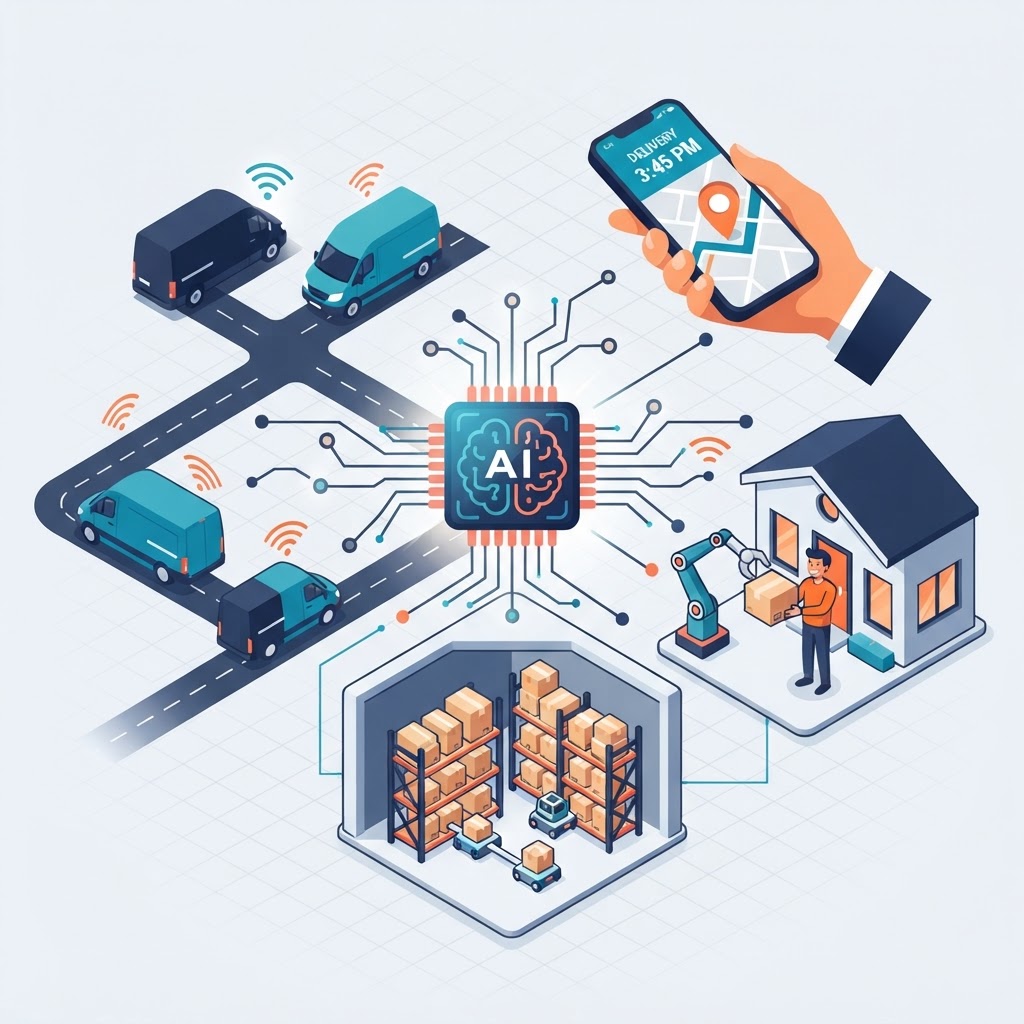
Not every parcel should ship with the same carrier. AI-based carrier-recommendation engines evaluate cost, transit time, lane reliability, and historical first-attempt delivery success per pin code, then auto-assign the optimal carrier for each order.
This is no longer a back-office optimization — it is a customer-experience lever because the right carrier for a fragile fashion order in Mumbai is not the right one for an electronics order in Indore.
Pitney Bowes' 2025 guidance on multi-carrier rate shopping shows how this same logic protects margin while also improving on-time performance.
4. AI-Generated Customer Communications
Once an exception is detected or an ETA is recalculated, generative AI can draft contextual, on-brand messages to the customer — proactively, in their preferred channel, in their language.
According to Masterofcode's roundup, 97% of service providers report that conversational AI improves customer satisfaction, and 41% of companies now use generative AI to draft customer responses.
The most effective brands are pairing this with branded tracking pages that turn the post-purchase wait into a marketing surface — not a black box.
5. Sentiment & Returns Intelligence
The feedback loop doesn't end at delivery. Sentiment analysis on post-delivery surveys, support transcripts, and reviews now feeds directly back into operational decisions — flagging which lanes, which SKUs, or which carriers are dragging CSAT down.
The Bottom Line
AI in delivery management is no longer a futuristic capability — it is, increasingly, table stakes. The brands building durable customer loyalty in 2025 are the ones treating the post-purchase experience as a product in its own right, with prediction, proactivity, and personalization baked in at every step.
If you are still relying on static shipping promises and reactive customer service for delivery issues, the gap between your CSAT and your AI-enabled competitors' is only going to widen.
See how AI-powered delivery management can lift your CSAT. Book a quick demo with our team today.
Akhilesh Srivastava
Sharing insights on AI-powered delivery management, eCommerce optimization, and post-purchase experience.
Related Resources
Improve your checkout conversion rates with accurate estimated delivery date predictions
The post directly addresses the need for replacing vague shipping windows with precise predictive ETAs.
Reduce WISMO tickets by offering customers a premium branded order tracking experience
The article highlights how accurate tracking reduces 'Where is my order?' anxieties and support center volume.
Drive customer satisfaction by sending proactive delivery notifications and delay alerts
This page supports the section on exception management by highlighting how automated alerts keep customers informed.
Scale your operations using advanced agentic AI for autonomous delivery management
The post focuses on the transition toward AI-powered logistics, which is the core capability offered by this platform.
Get Started
Ready to optimize your delivery experience?
See how FenixCommerce's AI-powered platform boosts conversions and reduces shipping costs.