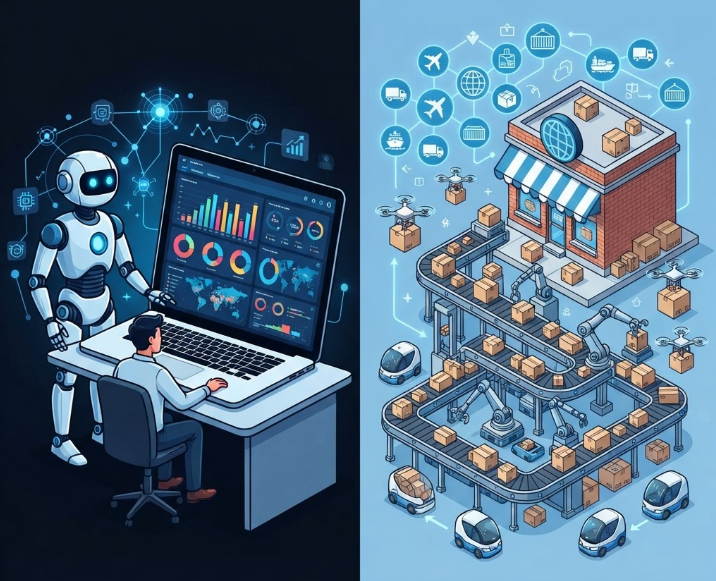
Last time, we looked at AI that shops for your customers. The bigger shift is happening on the other side of the counter: AI is starting to work for the people running the store.
A dozen stores vs. millions — the gap nobody's talking about
How many online stores are actually using AI to shop for customers right now — the kind where ChatGPT buys something on someone's behalf? Shopify's own president gave the real number in March: about a dozen. Out of millions of stores.
Compare that with the other side: AI helping the store owner, not the shopper. On Shopify's last earnings call, the number of merchants using its AI helper, Sidekick, grew about 4 times in a year. Merchants built over 12,000 mini-apps with it in a single quarter. AI-driven traffic to Shopify stores grew about 8 times over the same year.
The real story for 2026 is simple: the store-owner side of AI is moving faster than the shopper side.
AI "assistant" vs. AI "agent" — the difference that matters
People use these two words like they mean the same thing. They don't.
An assistant answers exactly what you ask it.
An agent figures out what you're trying to do, goes and finds the information itself, and comes back with something useful — even if you never told it where to look.
AI ASSISTANT
Responds to exactly
what you ask
AI AGENT
"For most store owners, the bottleneck was never the data. It was the distance between having the data and getting a clear answer from it."
What a store-owner AI agent can actually help with
None of this replaces a person's judgment. It simply shortens the time between asking a question and making a decision — which matters even more for a small team running the store.
Being smart isn't the same as being reliable
A capable AI model doesn't automatically make a reliable one. Five things need to be true first, and stores don't forgive mistakes here:
- Data — is the information up to date?
- Context — does it understand how the pieces connect?
- Tools — can it reach the systems it needs?
- Permission — is it allowed to see or touch what it's being asked about?
- Checking — how would anyone know if its answer was wrong?
A confident answer built on old shipping data is still a wrong answer. The more work is handed to AI, the more the data behind it matters — not less.
Why this matters to you, before it's fully built out
An AI agent is only as good as the information behind it. Ask it about delivery performance, and it can only be as accurate as the shipping and carrier data it's reading. It's the same problem we've written about on the customer-facing side — just pointed inward this time.
This is the layer FenixCommerce's Shipping Intelligence is built for: accurate, real-time delivery and carrier data. Whether a customer is checking out or a store's own AI is asking the question, the data underneath has to hold up either way.
Where this is headed
The customer-facing story got the headlines this year. The merchant-facing one is further along than most people realize — Shopify already describes Sidekick as connected directly to a store's live data, built to take action inside the admin, not just answer questions about it.
Next, we'll look at what Sidekick does well today, where it still falls short, and what it means to connect a tool like that to real shipping and delivery data.
Rather look before you talk to anyone? Watch our product videos first.
FenixCommerce
Sharing insights on AI-powered delivery management, eCommerce optimization, and post-purchase experience.
Related Resources
how agentic AI is transforming the landscape of autonomous commerce and shipping
The blog post explicitly distinguishes between AI assistants and AI agents, making this the most relevant page to explain how agentic AI functions in a logistics context.
a comprehensive platform for intelligent delivery and ecommerce shipping management
Since the article discusses Shopify merchants and AI-driven store growth, linking to the platform overview helps merchants see how to implement these tools at scale.
use advanced shipping analytics to optimize carrier performance and delivery insights
The blog highlights the shift toward using AI to manage the store-owner side, and this page shows exactly how data analytics helps those owners make informed decisions.
see how leading merchants leverage technology to drive operational growth and efficiency
The article uses statistics to prove AI growth; pointing readers to case studies provides real-world evidence of how merchants turn these technical shifts into business results.
Get Started
Ready to optimize your delivery experience?
See how FenixCommerce's AI-powered platform boosts conversions and reduces shipping costs.