Why Estimated Delivery Dates Matter More Than Ever
In today's hyper-competitive eCommerce environment, customers don't just want fast shipping — they want predictable shipping. According to a 2025 Baymard Institute study, 22% of online shoppers abandon their cart because the delivery timeline was unclear or too slow. Meanwhile, a McKinsey report found that 87% of consumers say delivery speed and transparency directly influence their purchase decisions.
The message is clear: if your product pages, cart, and checkout don't display accurate estimated delivery dates (EDDs), you're leaving revenue on the table.
What Are Estimated Delivery Dates?
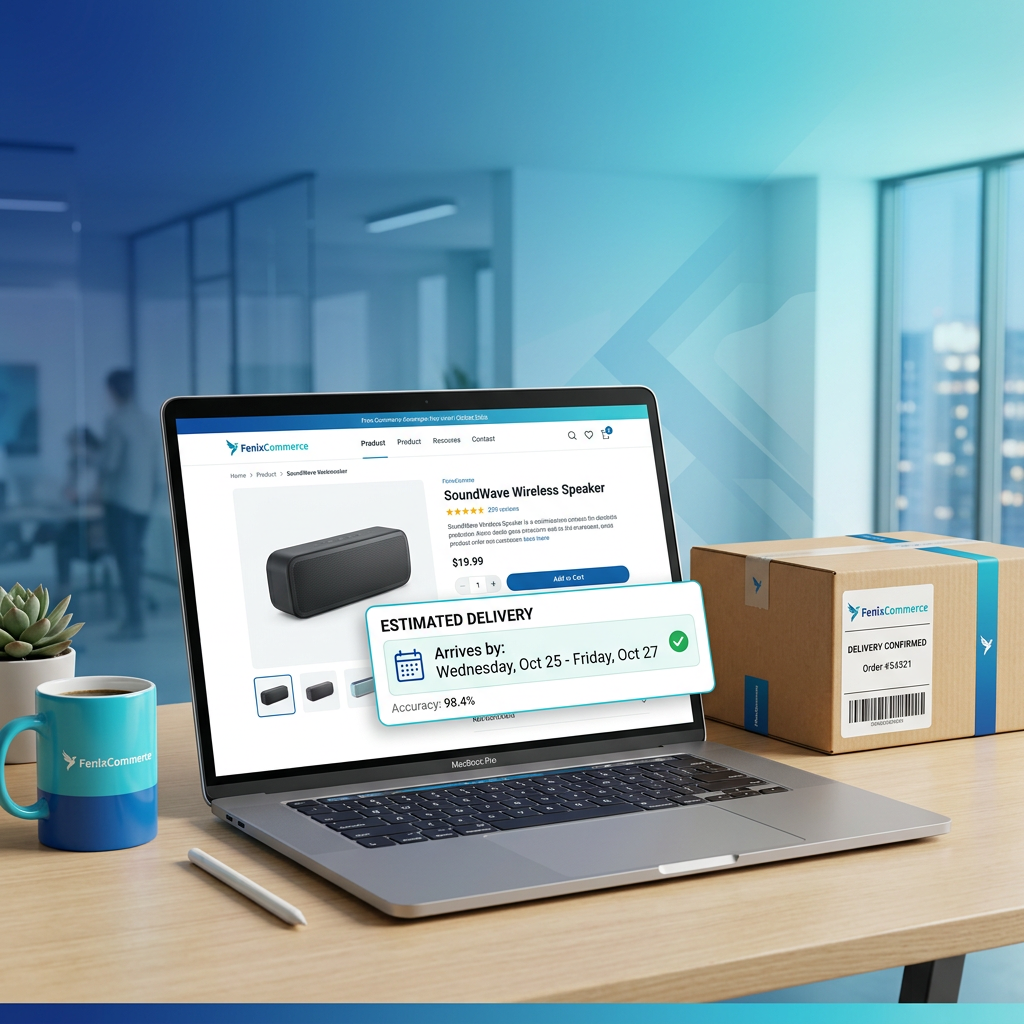
Estimated delivery dates are the predicted arrival window shown to a customer during the shopping journey — on the product detail page (PDP), in the shopping cart, and at checkout. Unlike vague shipping labels like "Standard (5-7 business days)," accurate EDDs tell customers the exact date they can expect their order.
For example, instead of seeing "Ships in 3-5 days," a customer sees: "Arrives by Thursday, April 10." This simple shift from ambiguity to certainty has a profound psychological impact on buying behavior.
The Business Impact: By the Numbers
The data supporting accurate delivery dates is compelling:
- 15-30% increase in conversion rates when accurate EDDs are displayed on PDPs (FenixCommerce client data)
- 35% reduction in cart abandonment at checkout when customers see a guaranteed delivery date
- 18% higher average order value when shoppers trust the delivery promise
- 72% fewer WISMO ("Where Is My Order?") inquiries when expectations are set accurately upfront
- 28% increase in repeat purchases from customers who received orders on time as promised
Why Most Delivery Date Estimates Are Wrong
Traditional delivery date calculations rely on static rules — fixed carrier transit times combined with simple cutoff logic. But real-world shipping is far more complex:
- Carrier variability: FedEx Ground from Dallas to Denver might average 3 days but fluctuate between 2-5 days depending on volume, weather, and seasonal capacity
- Fulfillment delays: Warehouse processing times vary by product, time of day, day of week, and current backlog
- Geographic nuances: Rural vs. urban delivery windows differ significantly, yet most systems use a single national average
- Multi-location complexity: Brands with multiple warehouses need to factor in which location will actually ship the order
- Holiday and peak season surges: Carrier networks slow down 20-40% during peak seasons, but static rules don't account for this
The result? Brands either over-promise (leading to missed deliveries and angry customers) or under-promise (losing sales to competitors who show faster dates).
How AI-Powered EDDs Solve the Problem
Modern AI-powered estimated delivery date solutions like FenixCommerce EDD use machine learning to analyze millions of historical shipments and predict delivery dates with 99.5%+ accuracy. Here's how:
1. Machine Learning Models Trained on Real Data
Instead of static transit tables, AI models analyze actual delivery performance across carriers, lanes, and time periods. They learn patterns that humans and rule-based systems miss — like the fact that UPS Ground from Los Angeles to Phoenix is consistently 1 day faster than their published transit time.
2. Dynamic Carrier and Fulfillment Intelligence
AI-powered systems integrate with your warehouse management system (WMS) to understand real-time processing capacity. If your Dallas warehouse has a 2-hour backlog on Tuesdays, the system adjusts the promise accordingly — something static rules simply cannot do.
3. Real-Time External Factors
Advanced systems incorporate weather data, carrier service alerts, regional disruptions, and holiday calendars to dynamically adjust predictions. When a winter storm hits the Midwest, delivery dates for affected lanes automatically extend.
4. Continuous Learning Loop
Every delivered package becomes training data. AI models continuously improve their accuracy, learning from both on-time deliveries and exceptions. Over time, predictions become increasingly precise for your specific product mix and fulfillment network.
Where to Display Estimated Delivery Dates
For maximum conversion impact, accurate EDDs should appear at every stage of the shopping journey:
Product Detail Page (PDP)
This is where the magic happens. Showing "Get it by Friday, April 10" directly on the product page — before the customer even adds to cart — creates urgency and eliminates the #1 purchase hesitation. FenixCommerce clients see a 15-25% conversion lift from PDP delivery dates alone.
Shopping Cart
Reinforcing the delivery promise in the cart prevents abandonment at a critical decision point. Customers who see a confirmed date in their cart are 40% less likely to abandon compared to those who see generic shipping tier labels.
Checkout
At checkout, the delivery date becomes a commitment. Displaying it alongside the shipping method selection gives customers the confidence to complete their purchase. This is also where intelligent carrier rate shopping can offer the best price for each delivery speed.
The Cost of Getting It Wrong
Inaccurate delivery dates don't just cost you one sale — they damage your brand:
- Customer churn: 41% of consumers say they would not reorder from a retailer that missed a delivery promise (Convey Consumer Study)
- Negative reviews: Late deliveries are the #1 driver of 1-star shipping reviews, which directly impact future conversion rates
- Increased support costs: Every WISMO call costs $5-8 to resolve. A brand with 100K monthly orders and a 15% WISMO rate spends $75K-120K/month on avoidable support
- Returns and chargebacks: When gifts arrive late or products miss a needed-by date, returns spike and chargebacks follow
Industry Leaders Are Setting the Standard
Amazon normalized the concept of showing exact delivery dates on every product page. Today, consumers expect the same experience from every retailer. Brands like Dermalogica, Bombas, and SwimOutlet have implemented ai-powered delivery dates and seen transformative results:
- Dermalogica: Significant reduction in split shipments through intelligent order routing, directly improving their bottom line
- Bombas: Improved customer satisfaction scores by setting — and meeting — accurate delivery expectations
- SwimOutlet: Reduced cart abandonment and boosted conversion rates with PDP-level delivery promises
Beyond Conversion: The Full Lifecycle Impact
Accurate EDDs don't just help pre-purchase. They're the foundation for the entire post-purchase experience:
- Branded tracking pages: Set against the original delivery promise, creating a consistent customer experience
- Proactive notifications: Alert customers early if a delivery will be delayed, turning a negative experience into trust-building transparency
- Incrementality measurement: Quantify the exact revenue lift from accurate delivery dates with rigorous A/B testing
Getting Started
Implementing accurate estimated delivery dates doesn't require a massive IT project. Modern solutions like FenixCommerce integrate with major eCommerce platforms — Shopify, Salesforce Commerce Cloud, BigCommerce, and Magento — in days, not months.
The ROI is immediate and measurable: higher conversions, lower cart abandonment, reduced WISMO inquiries, and happier customers who come back to buy again.
Ready to see how accurate delivery dates can transform your eCommerce metrics? Request a personalized demo and let our team show you the impact for your specific business.
FenixCommerce
Sharing insights on AI-powered delivery management, eCommerce optimization, and post-purchase experience.
Related Resources
Learn how to optimize your checkout experience with accurate estimated delivery dates
This page provides a deeper dive into the exact technology and features needed to implement the estimated delivery date strategies discussed in the article.
Improve your fulfillment strategy with intelligent order promise and routing capabilities
The blog post touches on the complexity of delivery logic, making this the ideal resource for readers looking to solve the backend fulfillment challenges mentioned.
Reduce customer support tickets by providing a branded order tracking experience
Since the article mentions that accurate dates reduce WISMO inquiries, this page offers the natural next step for managing customer expectations post-purchase.
Discover how to measure the real impact of delivery promises on your revenue
The blog references significant conversion rate increases, and this page explains how merchants can scientifically prove the ROI of their delivery date strategy.
See how leading brands achieved higher conversion rates with optimized delivery experiences
Providing real-world evidence from successful brands reinforces the data-driven claims made throughout the blog post.
Get Started
Ready to optimize your delivery experience?
See how FenixCommerce's AI-powered platform boosts conversions and reduces shipping costs.